
KOALA
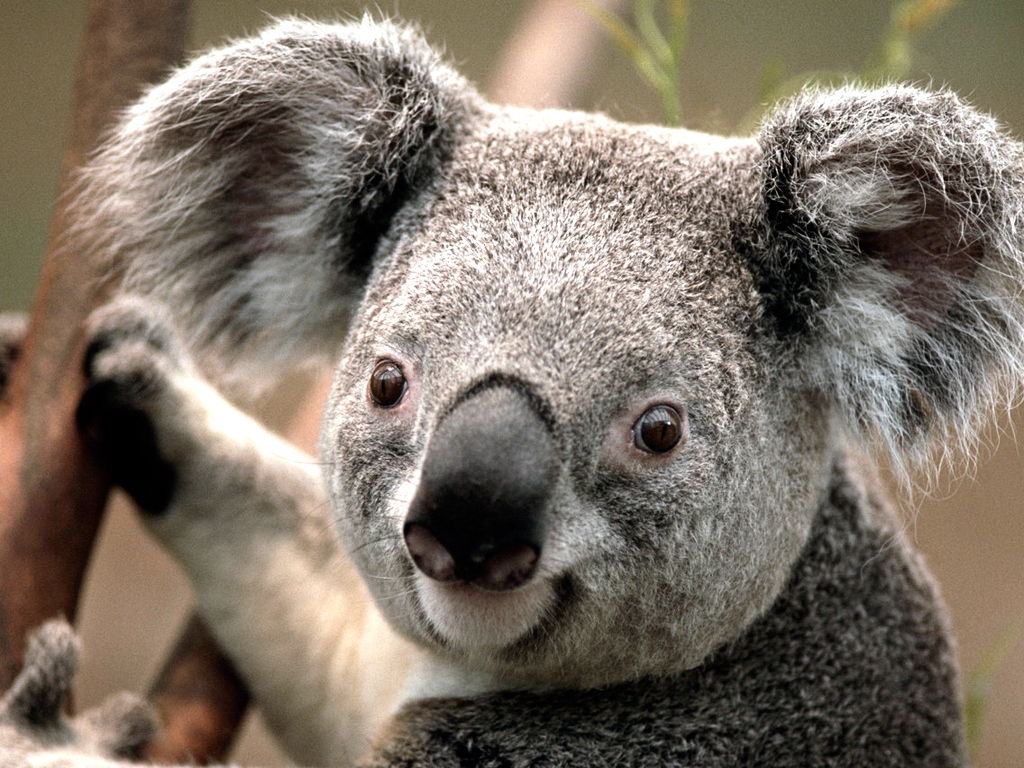
The koala or, inaccurately, koala bear[a] (Phascolarctos cinereus) is an arboreal herbivorous marsupial native to Australia. It is the only extant representative of the family Phascolarctidae and its closest living relatives are the wombats, which are members of the family Vombatidae. The koala is found in coastal areas of the mainland's eastern and southern regions, inhabiting Queensland, New South Wales, Victoria, and South Australia. It is easily recognisable by its stout, tailless body and large head with round, fluffy ears and large, spoon-shaped nose. The koala has a body length of 60–85 cm (24–33 in) and weighs 4–15 kg (9–33 lb). Fur colour ranges from silver grey to chocolate brown. Koalas from the northern populations are typically smaller and lighter in colour than their counterparts further south. These populations possibly are separate subspecies, but this is disputed.
Koalas typically inhabit open eucalypt woodlands, and the leaves of these trees make up most of their diet. Because this eucalypt diet has limited nutritional and caloric content, koalas are largely sedentary and sleep up to 20 hours a day. They are asocial animals, and bonding exists only between mothers and dependent offspring. Adult males communicate with loud bellows that intimidate rivals and attract mates. Males mark their presence with secretions from scent glands located on their chests. Being marsupials, koalas give birth to underdeveloped young that crawl into their mothers' pouches, where they stay for the first six to seven months of their lives. These young koalas, known as joeys, are fully weaned around a year old. Koalas have few natural predators and parasites, but are threatened by various pathogens, such as Chlamydiaceae bacteria and the koala retrovirus.
Koalas were hunted by Indigenous Australians and depicted in myths and cave art for millennia. The first recorded encounter between a European and a koala was in 1798, and an image of the animal was published in 1810 by naturalist George Perry. Botanist Robert Brown wrote the first detailed scientific description of the koala in 1814, although his work remained unpublished for 180 years. Popular artist John Gould illustrated and described the koala, introducing the species to the general British public. Further details about the animal's biology were revealed in the 19th century by several English scientists. Because of its distinctive appearance, the koala is recognised worldwide as a symbol of Australia. Koalas are listed as Vulnerable by the International Union for Conservation of Nature. The animal was hunted heavily in the early 20th century for its fur, and large-scale cullings in Queensland resulted in a public outcry that initiated a movement to protect the species. Sanctuaries were established, and translocation efforts moved to new regions koalas whose habitat had become fragmented or reduced. Among the many threats to their existence are habitat destruction caused by agriculture, urbanisation, droughts and associated bushfires, some related to climate change. Increased habitat loss may also increase risks from vehicle traffic, dog attacks, pesticides in waterways, and increased food competition.
The word koala comes from the Dharug gula, meaning no water. It was at one time thought, since the animals were not observed to come down from trees often, that they were able to survive without drinking. The leaves of the eucalyptus tree have a high water content, so the koala does not need to drink often.[8] But the notion that they do not need to drink water at all was shown to be a myth. Although the vowel 'u' was originally written in the English orthography as "oo" (in spellings such as coola or koolah), it was changed to "oa", possibly in error.Because of the koala's supposed resemblance to a bear, it was often miscalled the koala bear, particularly by early settlers.The generic name, Phascolarctos, is derived from the Greek words phaskolos "pouch" and arktos "bear". The specific name, cinereus, is Latin for "ash coloured".